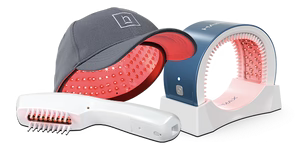
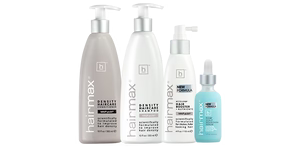
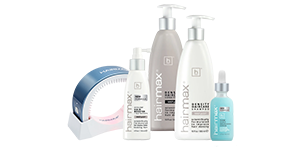
At HairMax, we care, and that is why our 7 clinical studies were conducted at prestigious research universities throughout the U.S., including the Cleveland Clinic, the University of Miami and the University of Minnesota, applying the highest standards in the industry.
HairMax has invested in more research and clinical studies on light energy for hair growth than any other company. Seven clinical studies with 460 men and women have been completed conclusively proving it works safely and effectively – with NO worrisome side effects.
These studies were conducted by leading scientists and physicians in the field of hair loss. Our studies were conducted at top medical research centers including the Cleveland Clinic, the University of Miami and University of Minnesota.
The Result? 90% success rate, 129 additional new hairs per in. sq. , 7 FDA Clearances. 6 published peer reviewed articles.
Monotherapy in a 54-year old male A) Before Treatment, B )Improvement after 6 months C) 12 months of low level light laser therapy
Filling in of hairline. Substantial increase in hair density.
Overall improvement of hair quality. (After 26 weeks)
Substantial increase in hair density.
Overall improvement of hair quality. (After 26 weeks)
(Individual results may vary. Photos on this page may not represent typical results you can experience)
At baseline, a circle approximately 1 inch in diameter, positioned in the transition zone of the scalp, was identified as the site for hair clipping and tattooing. Within this site was the target area for the hair density evaluation during the laser hair growth treatment. Subjects were evaluated at baseline, week 8, week 16 and week 26. Digital images captured by FUJI S2 were taken of the target site within the clipped area following the site preparation. A 19 inch monitor was used for blinded evaluation.
The clinical studies included males & females between the ages of 25-60 yrs. with a diagnosis of Androgenetic Alopecia who had been experiencing active hair loss within the last 12 months. The inclusion criteria for males required a Norwood- Hamilton classification of IIa to V and Fitzpatrick skin types I to IV. Click for Classification Charts. The inclusion criteria for females required a Ludwig (Savin) classification of I-4, II-1, II-2, or frontal.
All subjects were randomized for laser hair loss treatment analysis. A biostatistician calculated the study to be of a proper size to gauge statistically significant results of hair growth and hair density. Subjects were instructed to use the laser hair growth treatment device three times per week on non-consecutive days, 10-15 minutes per treatment for a total of 26 weeks. Hair density measurements were performed at baseline, at 16 and 26 weeks. Additional clinical visits were scheduled to monitor the laser hair loss treatment progress and overall hair growth.
Mean Terminal Hair Count Changes From Baseline in Males 26 Weeks, Last Observation Carried Forward
Mean Terminal Hair Count Changes From Baseline in Females 26 Weeks, Last Observation Carried Forward
2014 – Results of 4 clinical studies in males and females
Published in April 2014 in the peer review medical journal, The American Journal of Clinical Dermatology.
Key Conclusions
2014 – Results of a retrospective study to evaluate efficacy and safety as mono or concomitant therapy
Published in April 2014 in the peer review journal, the International Journal of Trichology.
Key Conclusions
2009 – Results of key clinical study in males leading to first FDA Clearance
Published in May 2009 in the peer review journal, Clinical Drug Investigation. 26 week study comparing the LaserComb to the sham device,
Key Conclusions
2003 – Results of hair regrowth and increased tensile strength
Published in November 2003 in the peer review journal, International Journal of Cosmetic Surgery and Aesthetic Dermatology
Key Conclusions