



It often starts with a second look in the mirror. The temples seem a little higher, or the crown looks thinner under the bathroom light. If your dad or grandfather lost hair, that moment carries extra weight, because it's easy to wonder whether you're watching the same story begin.
Yes, the most common type of hair loss is hereditary, and a family history raises your risk. But genes aren't a guarantee, they come from both sides of the family, and the early stage is when you have the most options.
What actually happens when hair thins
The medical name for the most common type is androgenetic alopecia, and it affects both men and women. According to MedlinePlus Genetics, it tends to run in families, and having a close relative with pattern hair loss raises your risk. Researchers link it to DHT, a hormone made from testosterone. Variations in the androgen receptor gene (AR) may make follicles more easily activated by androgens, though how that leads to hair loss isn't fully understood.
What you can see is miniaturisation: follicles gradually shrink, and each new hair grows back finer and shorter. A healthy hair's growth phase can last two to eight years, followed by a resting phase of two to four months, as Hairmax explains in its guide to understanding hair loss. When miniaturisation sets in, hairs spend less time growing and more time resting. That's why pattern hair loss is gradual and predictable. It tends to start at the temples and crown in men, and as diffuse thinning at the part in women (see Healthdirect's page on female pattern hair loss).
The gradual part matters, because it gives you time. Follicles that are weakened but still alive are the ones that respond best to treatment.
The "it comes from your mother's side" myth
You've almost certainly heard that baldness comes from your mum's dad. There's a kernel of truth here. The AR gene sits on the X chromosome, and men inherit their X from their mother.
But one gene isn't the whole story. Researchers believe many genes, plus environmental factors, contribute, and the exact pattern of inheritance isn't fully understood. Some men look just like their father at 50, some take after their maternal grandfather, and many don't resemble either. So your mum's side is worth checking, but it isn't the whole picture, and your dad's side matters too.
Why brothers can lose hair differently
If genes were the only factor, brothers would lose hair in the same pattern and at the same pace. They usually don't. Each sibling inherits a different mix of variants, so one may carry more of the risk-raising ones than the other.
Other things can also add to shedding along the way. Serious illness, big stress, crash dieting and low iron are all known to trigger extra shedding, which can make thinning look worse than it would otherwise. These don't cause inherited pattern loss, but they can pile on top of it, so they're worth sorting out with your GP.
Hereditary or something else? A quick check
| What you notice | Points towards hereditary | See your GP or a trichologist |
|---|---|---|
| Where it's thinning | Temples and crown (men), or the part and top of the scalp (women) | Patchy bald spots or hair coming out in clumps |
| How fast | Gradual, over months and years | Sudden, over a few weeks |
| Hair quality | Finer, shorter regrowth | Itchy, sore, flaky or red scalp |
| Family history | Close relatives on either side | No family history and unexplained change |
If you tick boxes in the middle column, hereditary pattern hair loss is a likely candidate. If you tick any in the right-hand column, get it checked first. A GP can test for common causes like low iron or a thyroid problem.
Why the early stage matters
Hair follicles don't switch off overnight. At first they're weakened but still producing hair, just thinner hair. Left alone, the affected areas slowly widen, and follicles that have stopped completely can't be revived by any treatment. That's the reason to start early, not after the thinning is advanced. Acting on early signs isn't overreacting. It's giving your follicles the most to work with.
Where laser hair therapy fits
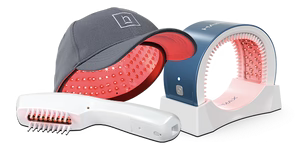
Low-level laser therapy delivers medical-grade laser light to the scalp, and it's designed to stimulate follicles that are weakened but still alive. You can read more about how Hairmax technology works.
Hairmax devices are FDA-cleared, and the company's clinical research covers seven trials with 460 participants, six of them double-blind and run across multiple centres.
Figures reported by Hairmax. They are averages, and individual results vary.
It's for hereditary pattern thinning only, so other causes need treating first. Hairmax's suitability guide says the devices suit men at stages IIa to V on the Norwood-Hamilton scale and women with early-stage thinning (Ludwig-Savin I and II) or thinning at the front. They were tested on light to medium skin tones (Fitzpatrick types I to IV), and Hairmax can't confirm results on darker skin.
The routine is three sessions a week, on non-consecutive days. Hair is slow, so most people notice changes between four and six months, which is why consistency matters more than any single session. To compare options, see the device comparison or browse the full laser range. Some people like a bundle with haircare, so check the bundles and the Density haircare range. You can also see real success stories before you decide.
Questions people ask
If my dad is bald, will I definitely lose my hair?
No. Genes raise your likelihood and influence the timing, but they don't guarantee the outcome. Plenty of men with a strong family history keep a lot of hair into later life.
Will my hair loss follow the same pattern as my dad's?
Not necessarily. Because many genes from both sides are involved, your pattern might resemble your dad's, your maternal grandfather's, or a mix.
Can early thinning be stopped or improved?
Early-stage thinning, where follicles are miniaturising but still alive, tends to respond best to consistent treatment. Follicles that have stopped completely can't be revived, which is why timing matters.
Does laser therapy work on genetic hair loss?
Hairmax devices are designed for hereditary pattern thinning, and the company's trials were run on people with it. Results vary from person to person.
Is hereditary hair loss only a men's issue?
No. Women get it too, usually as thinning across the top of the scalp rather than a receding hairline. If you're not sure what's behind your thinning, start with your GP.
When should I start?
When you first notice changes. If hair loss runs in your family, you can also build good scalp habits before any changes show.
What to do with this information
A family history isn't a sentence. It's a heads-up, and hereditary hair loss is one of the more manageable types because it's gradual and predictable. Book a GP visit to rule out other causes, take a baseline photo in good light, and if laser therapy sounds right, check whether you're a good fit. Hairmax also offers a one-year limited warranty and a 6-month money-back guarantee on its devices (conditions apply, including return shipping and a 20% fee), set out on the warranty page.
Ready to take the first step?
Explore the Hairmax laser range, or check whether it's right for you first.
Shop laser devices Is it right for me?Sources: MedlinePlus Genetics: Androgenetic alopecia | Healthdirect: Female pattern hair loss | Hairmax: Understanding hair loss
This article is general information, not medical advice, and results vary from person to person. Talk to your GP about your own hair loss.